By default, Android prints notification text — message bodies, OTP codes, work alerts — straight onto the lock screen. That is handy until a stranger, a coworker, or a commuting neighbor reads it over your shoulder. The good news: Android has layered controls, and you can hide as much or as little as you like in a few taps.
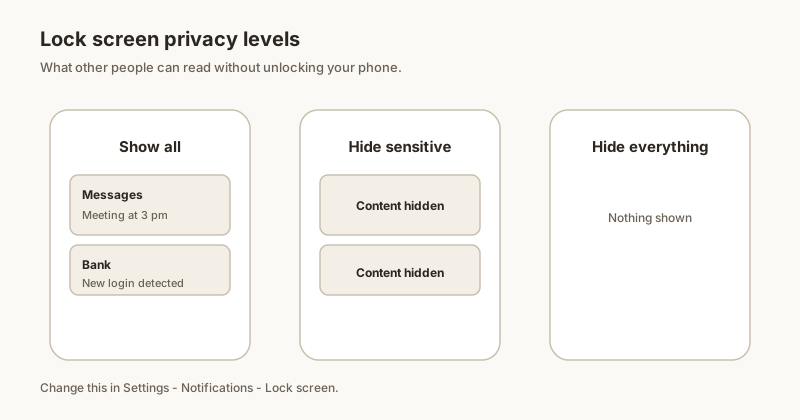
Hide all sensitive content
The quickest privacy win is a global rule:
- Open Settings → Notifications.
- Tap Lock screen (some phones call it Notifications on lock screen).
- Choose Hide sensitive content. The app icon and sender stay, but the body becomes "Contents hidden".
- Or pick Don't show notifications at all for maximum privacy.
This single switch covers every app at once. If you only want to protect a couple of apps, skip to per-app control below.
Hide content for one app
You rarely need an all-or-nothing rule. To keep calendar and delivery alerts visible while hiding personal chats:
- Open Settings → Notifications → App notifications.
- Tap the app (for example Messages or WhatsApp).
- Open its notification category (see our channels guide).
- Set Lock-screen to Hide for sensitive categories, leaving others visible.
Per-app control is the sweet spot: important alerts still surface, private ones stay blank until you unlock.
Keep the sender, hide the body
Hide sensitive content is purpose-built for this. You will still see "Messages: Contents hidden" — enough to know who pinged you, without exposing what they said. This is usually better than hiding everything, because you keep the at-a-glance awareness.
Hide everything until unlock
If your phone is often left face-up in public, choose Don't show notifications at all. Nothing appears on the lock screen; you only see notifications after unlocking. Pair this with muting non-urgent apps so the lock screen stays clean even after you unlock.
Android 12 to 15 paths
The setting lives in slightly different places across versions and makers:
- Android 12–13 (stock): Settings → Notifications → Notifications on lock screen.
- Android 14: Settings → Notifications → Lock screen → Sensitive notifications.
- Android 15: same as 14; some builds add a separate Hide sensitive content toggle under the lock-screen menu.
- Samsung (One UI): see our Samsung guide — Settings → Lock screen → Notifications.
- Pixel: Settings → Notifications → Lock screen.
- Xiaomi / Redmi: see our Xiaomi guide.
Privacy with Dingpin
Dingpin is built private by design: notifications are handled on your device, with no account and no cloud sync. You decide what to pin, and pinned items live only on your phone. Layer it under hidden lock-screen content and you get both convenience and real peace of mind.
The global hide-content setting
On most Android phones:
- Settings → Notifications → Notifications on lock screen.
- Choose "Hide sensitive content" or "Hide all."
"Hide sensitive content" keeps app icons and names visible but masks message previews. "Hide all" removes the lock-screen notification entirely.
Per-app overrides
For finer control:
- Settings → Apps → [app] → Notifications → Lock screen.
- Choose Show all / Hide sensitive / Hide entirely.
Useful when you want messages from important contacts visible but banking alerts hidden.
Brand-specific paths
- Pixel. Settings → Notifications → Notifications on lock screen.
- Samsung One UI. Settings → Notifications → Lock screen notifications.
- Xiaomi HyperOS. Settings → Notifications → Lock screen.
What counts as "sensitive"
Android automatically flags notifications as sensitive when:
- The app category is banking, OTP, password manager, or healthcare.
- The notification uses a sensitive-content flag (e.g., SMS verification codes).
- The user has explicitly marked the channel as sensitive.
When "Hide sensitive content" is on, these alerts show an icon and app name but no preview.
Always-on display interaction
The AOD respects lock-screen visibility settings. If you want different behavior on AOD vs. lock screen, configure each separately in Settings → Display → Always On Display → Notifications.
For related guides, see hiding lock screen notifications for privacy, Samsung, Pixel, and Xiaomi.